
The prime minister will have a tight schedule in the Philippines as besides attending the 15th ASEAN-India summit and 12th East Asia summit on November 14, he will have a series of other engagements including bilateral meetings with several leaders.
'The real story of 2025 is that India officially stopped being a 'market of the future' and started acting as the world's primary economic engine.'

United States President Donald Trump on Monday praised India and Prime Minister Narendra Modi without naming him, saying 'India is a great country with a good friend of mine at the top'.
If they act now, they can reshape the strategic map of Asia without firing a shot. If they wait, the next opportunity will come only after a serious Taiwan Strait incident -- by which time the price will be far higher, and the room for boldness far smaller -- the opportunity may well be lost by then. The question is no longer whether this can or should be done, points out Varun Arya.
Developing relations with the Taliban is needed, but plunging headlong into Afghanistan without due thought will be akin to the rooster entering a KFC outlet, warns Lieutenant General Prakash Katoch (Retd).

Prime Minister Narendra Modi on Thursday asserted that the world community must reject any linkage between religion and terrorism while formulating a "genuinely international" partnership in the fight against all forms of terror acts.

The 2025 US National Security Strategy marks a major pullback, with America turning backward and effectively allowing China greater dominance in Asia. while long-time partners like India are left to face an increasingly unstable global order largely on their own, observes Rajeev Srinivasan.

Ever since the Quad started taking shape in 2007, China has been saying that the four-member grouping will be bound to fail. But much to the chagrin of Beijing, it picked up pace in the recent years emerging as a premier strategic group especially challenging China's assertiveness in the disputed South China Sea.

Modi will have a number of high-profile multilateral and bilateral meetings with global leaders including United States Vice President Mike Pence and Singapore premier Lee Hsein Loong.

A dominant NorthEast United FC are standing in the way as giant-killers Diamond Harbour FC look to script history by becoming the first debutant team to win the Durand Cup title in Kolkata on Saturday.
The era where nations thrived through rigid alignments is giving way to an age where the connective State defines power. For India, that era has arrived, points out Dr Nishakant Ojha.

Prime Minister Manmohan Singh left for Bali and Singapore on Thursday.
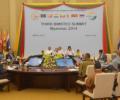
Leaders from the seven-nation Bay of Bengal Initiative for Multi-Sectoral Technical and Economic Cooperation on Tuesday vowed to jointly combat the growing threat of terrorism, transnational crimes and drug trafficking and agreed to intensify efforts to enhance connectivity and cooperation in areas like trade, energy and environment.
The agenda prepared by ministers will be discussed by Prime Minister Narendra Modi and other RCEP leaders in Nonthaburi, a city north of Bangkok, on November 4, the official deadline to close talks.

Russian foreign ministry spokeswoman Maria Zakharova on Monday denied the media reports of taking Foreign Minister Sergei Lavrov to hospital with a heart condition and called it the 'height of fakery', several media reported.
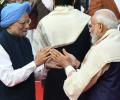
While Narendra Modi spent fewer days abroad than his predecessor -- 275 days versus Dr Singh's 306 - he has travelled more widely than any other Indian PM.

New Delhi, while opting not to retaliate yet to the American tariffs, has in recent weeks sought to reinforce its friendship with Moscow, and recalibrate its ties with Beijing rather than surrender to Washington's diktats.
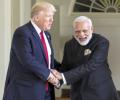
Trump lauds Modi, saying he has been working successfully to bring the vast country and its people together.
A day after attending the India-Asean summit and the East Asia Summit in furtherance on India's Look East policy, Prime Minister Manmohan Singh on Sunday credited Singapore for leading to the strategic shift in the nation's foreign and economic policies.

Prime Minister Narendra Modi on Tuesday met Myanmar's President U Thein Sein to begin a string of bilateral meetings with over 40 world leaders during his 10-day three-nation tour on the margins of key multilateral summits in Myanmar and in Australia and a visit to Fiji.
If the US' renewed closeness with Pakistan ends up strengthening Pakistan's military, it will clearly show that Washington no longer wants a strong India and could be ready to let China dominate Asia, notes Colonel Anil A Athale (retd).
Calling for cooperation among Asia Pacific countries to tackle the global economic uncertainty, Prime Minister Manmohan Singh on Thursday said the vast growth potential of India and these nations can be realised only by inculcating a "collective temper".
Pakistan Prime Minister Shehbaz Sharif said on Tuesday that his country respects Russia's relations with India, as he called for strengthening Islamabad's ties with Moscow during his talks with Russian President Vladimir Putin in Beijing.

While addressing the 14th ASEAN-India summit, the PM noted that growing radicalism and spread of extreme violence are the other security threats.
On the sidelines of the India-ASEAN summit, Prime Minister Singh might also have bilateral meetings with some of the leaders.

Both India and China are in Phnom Penh to participate in the two-day East Asia Summit, an offshoot of the Asean meet. China and India, along with the US, Russia, Australia, New Zealand, Japan and South Korea are participating countries in EAS, besides the 10 Asean members.

Prime Minister Narendra Modi has said that the Quad is not against anyone, but for a rules-based international order and respect for sovereignty, in a veiled reference to China.
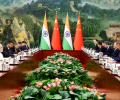
Chinese President Xi Jinping told Prime Minister Narendra Modi that India and China should approach their relations from a "strategic" and "long-term perspective" during their talks in Tianjin. Xi also emphasized upholding multilateralism and working towards a multipolar world.
Apart from emphasising the importance of India's economic development, and its re-integration into the global economy, Dr Singh has repeatedly emphasised the importance of the ideas that define the Indian civilization and the Indian Republic for global peace, security and challenges, ranging from terrorism to pandemics.

Trump couldn't care less anymore about the Israeli demand for Iran's 'de-nuclearisation' and 'de-militarisation.' Trump pins hopes on a grand bargain with Iran as a partner in America First, argues Ambassador M K Bhadrakumar.

The upcoming Durand Cup may have only six Indian Super League (ISL) teams in the fray, down from 12 last season.
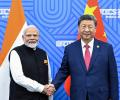
India and China celebrated the 75th anniversary of their diplomatic relations on Tuesday, with leaders from both countries exchanging congratulatory messages. The anniversary comes as the two countries are working to restore ties after a four-year freeze due to the military standoff in eastern Ladakh. Both countries have expressed a willingness to enhance strategic mutual trust and step up cooperation in various fields. The two sides are also exploring ways to rebuild ties and promote people-to-people exchanges.
Prime Minister Narendra Modi on Wednesday made his Instagram debut, sharing a picture from the venue of the ASEAN summit.

In the midst of a hectic campaign schedule, Modi needs to find time to meet visiting leaders and attend the East Asia Summit in the Philippines.

He also reiterated India's strong support in the fight against terrorism with Sri Lanka, which saw the country's worst terror attack on Easter Sunday.
Prime Minister Manmohan Singh has put off his visit to Japan from Thursday for the annual summit in view of the sudden political developments in that country.

It was clear in Brunei at the 8th East Asia Summit that China doesn't want the South China Sea issue to even dominate the discussion, reports Sheela Bhatt, who is part of the prime minister's media contingent to the summit
India and South Korea have reached an agreement on civil nuclear cooperation.

While Modi has spent fewer days abroad than his predecessor (270 days versus Dr Singh's 306), he has travelled more extensively and actively than any other Indian PM.
